If you keep procrastinating, losing focus, rereading the same notes and wondering what you should study next, the problem might not be motivation. The problem might be the way studying begins.
There is a strange moment that happens before studying.
You sit down.
Open the laptop.
Look at the PDF.
Maybe open your notes.
And then...
Nothing.
You know you should study.
You may even want to study.
But somehow the distance between having material and actually learning something from it feels enormous.
So you check your phone.
Get some coffee.
Clean the desk.
Watch one video.
Tell yourself you will start in ten minutes.
And suddenly an hour is gone.
It is easy to look at this situation and conclude:
I am lazy.
Or:
I have no discipline.
Or:
I just can't focus on studying.
But those explanations may be too simple.
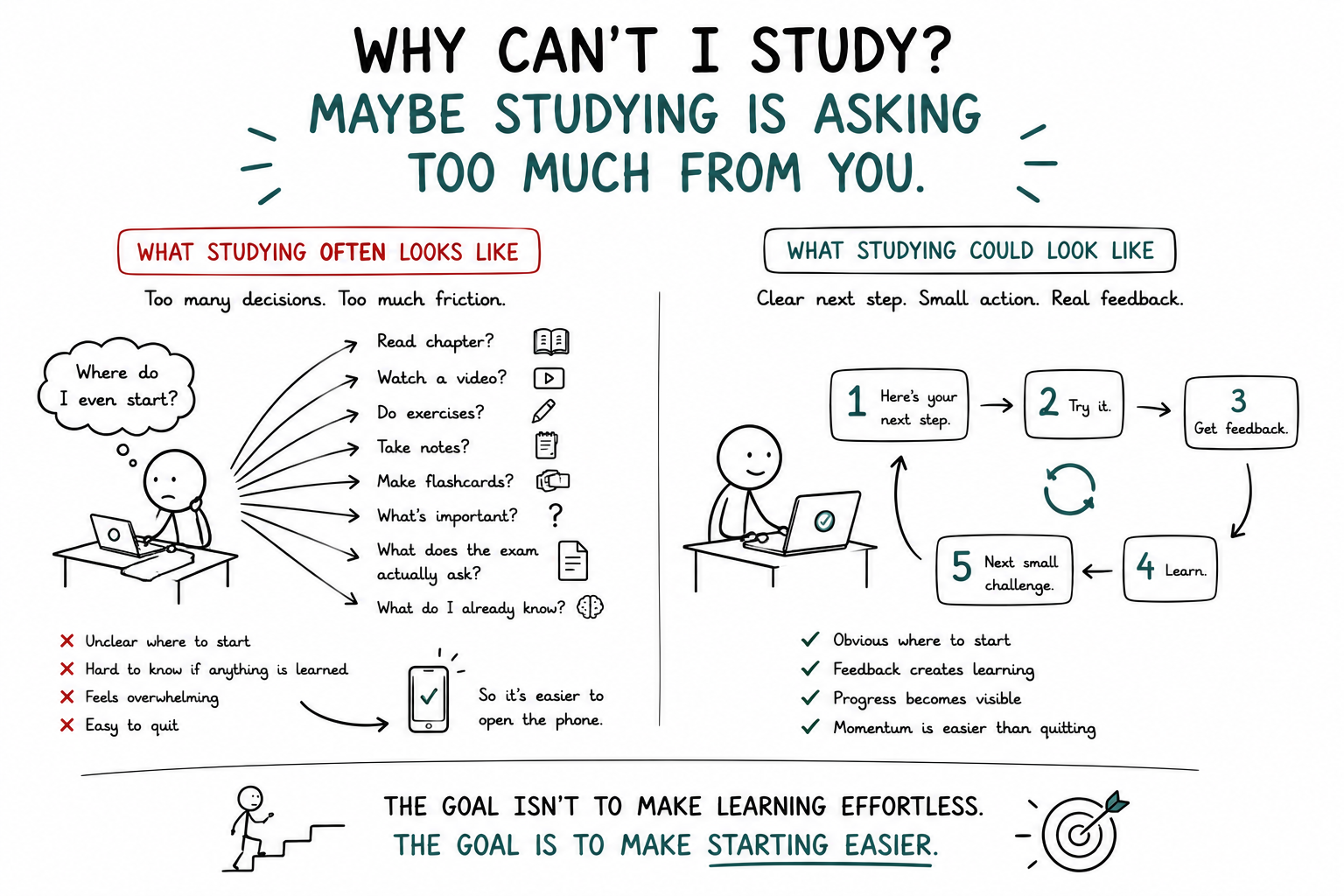
Maybe studying has quietly become a task with far too many decisions attached to it.
And maybe the first problem we should solve is not:
How do we make students work harder?
But:
How do we make starting easier?
"I Can't Start Studying"
Search for advice about studying and you will find endless variations of the same question.
How do I start studying?
Why can't I study?
How do I stop procrastinating?
How do I study when I don't feel like it?
How do I focus?
How do I motivate myself?
These sound like different problems.
Often, they are different expressions of the same underlying friction.
Imagine a student opening a 70-page PDF.
What exactly should happen next?
Read page one?
Highlight important sections?
Take notes?
Make flashcards?
Search YouTube for an explanation?
Create a study plan?
Look at the exam requirements?
Try to remember what the teacher said three weeks ago?
The student is supposedly doing one thing:
studying.
But cognitively, they are being asked to make dozens of decisions before meaningful learning even begins.
And every decision creates another opportunity to quit.
Studying Is Often Poorly Defined
"Study for the exam."
It sounds like an instruction.
It really isn't.
Compare it with:
Answer these five questions.
That is concrete.
You know where to start.
You know when you have completed it.
You get immediate information about whether you understood something.
"Study chapter four" provides almost none of that.
The student has to invent the activity themselves.
This may partly explain why someone can spend three hours "studying" and still feel unsure whether anything actually happened.
They read.
Highlight.
Reread.
Organize.
Perhaps copy notes.
But the uncomfortable question remains:
Do I actually know this?
That uncertainty is expensive.
Because progress is difficult to feel when there is no clear feedback loop.
The Problem With Rereading
Rereading feels productive.
The material becomes familiar.
Sentences seem easier the second time.
Concepts start looking recognizable.
And familiarity can easily be mistaken for knowledge.
Then the exam arrives.
The notes are gone.
The PDF is closed.
And suddenly the brain has to produce the answer without seeing it.
That is a completely different task.
This is why active recall and retrieval practice matter.
Instead of asking:
Does this look familiar?
you ask:
Can I explain this without looking?
Instead of reading an answer again, you attempt to produce it.
Instead of assuming you understand the chapter, you test yourself.
That small shift changes studying from passive exposure into an information loop:
Attempt → feedback → correction → new attempt.
Now progress becomes visible.
"But I Don't Know What Questions to Ask"
And here we arrive at another hidden problem.
Good advice often tells students:
Test yourself.
Fine.
On what?
Imagine having lecture slides, notes, a textbook and three PDFs.
Creating good questions from all of that is itself work.
A motivated student may do it.
A skilled student may already know how.
But what about the student who is struggling just to begin?
We repeatedly give people learning techniques that require them to already possess the executive skills needed to implement those techniques.
Make flashcards.
Create practice questions.
Build a study schedule.
Identify the important concepts.
Prioritize weak areas.
Use spaced repetition.
Track your progress.
All useful advice.
But there is a strange contradiction here.
The students who need the most help often receive systems that require the most self-management.
From Notes to Action
What if studying began differently?
Imagine uploading your notes.
Or your lecture slides.
Or the PDF you are supposed to learn.
And instead of being greeted by another empty workspace, the system immediately gives you something small to do.
A question.
Then another.
You answer incorrectly.
Good.
Now something useful has happened.
The system has learned something about what you do not yet understand.
You answer correctly.
Good again.
Now it can decide whether to increase the difficulty, move forward or revisit the concept later.
The important transformation is not:
PDF → prettier notes
It is:
material → action.
That distinction matters.
Because a student does not necessarily need more information.
Often, they need a next move.
"What Should I Study First?"
This becomes especially important when an exam gets closer.
Students rarely have unlimited time.
Eventually the question changes from:
What does this course contain?
to:
What should I study right now?
That is a prioritization problem.
Suppose you understand 80% of one chapter and 20% of another.
Should both receive equal attention?
Probably not.
Suppose you keep answering the same type of question correctly.
Do you really need another ten repetitions?
Probably not.
Suppose there is one concept that repeatedly causes other questions to fail.
That concept may deserve attention first.
Good studying should therefore become increasingly selective.
The goal is not to spend equal time everywhere.
The goal is to identify where another minute of effort is most valuable.
Exam Tomorrow. Haven't Studied.
Then there is the extreme version.
The exam is tomorrow.
You have barely studied.
Your notes are everywhere.
You have six hours.
Maybe four.
At that point, telling someone to "create a comprehensive study schedule" borders on comedy.
They need triage.
What matters most?
What do they already know?
What can realistically still be learned?
Which concepts appear foundational?
Where are the largest knowledge gaps?
What should they stop wasting time on?
Last-minute studying will never be ideal.
But poor circumstances make prioritization more important, not less.
A useful learning system should not simply say:
You should have started earlier.
It should help the student make the best decision from where they are now.
Why Do I Forget Everything I Study?
Another common frustration appears after the studying supposedly worked.
Yesterday, you knew it.
Today, it feels blurry.
Next week, it may be gone.
Students often interpret forgetting as failure.
But forgetting is not evidence that learning is broken.
Forgetting is part of the process.
The important question is what happens next.
If knowledge is retrieved again before it disappears completely, the memory can strengthen.
This is where spaced repetition becomes useful.
But spaced repetition without intelligent prioritization can also become mechanical.
Not every fact deserves the same repetition schedule.
Not every mistake means the same thing.
Sometimes an incorrect answer means the student forgot a detail.
Sometimes it reveals a much deeper misunderstanding.
A useful system should be able to distinguish between those.
Studying Should Diagnose, Not Just Deliver
Traditional learning materials mostly deliver information.
Page after page.
Slide after slide.
Video after video.
But learning also requires diagnosis.
What does this person already know?
What do they misunderstand?
What are they guessing?
Which concepts are fragile?
Where are they improving?
When should the system explain something?
When should it ask another question?
And perhaps most importantly:
When should it stop helping?
Because an AI tutor that immediately gives you every answer may produce a pleasant experience while weakening the exact mental effort required for learning.
The best learning tool may sometimes need to resist being helpful.
It may need to ask:
Try again.
Or:
Explain why.
Or:
What makes you think that?
Or simply:
Are you sure?
That friction is not necessarily bad UX.
In learning, some friction is the product.
The Difference Between Helpful Friction and Bad Friction
There are two very different types of difficulty.
One is useful:
Remembering.
Reasoning.
Making connections.
Explaining.
Trying.
Failing.
Trying again.
The other is mostly waste:
Wondering where the material is.
Deciding how to organize it.
Figuring out what to study.
Creating your own questions.
Building the perfect schedule.
Searching for the right page.
Trying to decide whether you have studied enough.
A good learning system should remove as much administrative friction as possible while preserving cognitive friction.
That may be one of the most important design principles for AI in education.
Do not remove the thinking.
Remove the obstacles surrounding the thinking.
How Do You Make Studying a Habit?
There is also a behavioral dimension.
People often imagine habits being created through enormous discipline.
But habits usually become easier when the beginning of the behavior becomes predictable.
The person does not need to negotiate with themselves every time.
They know what happens next.
Open the app.
One question appears.
Answer.
Continue.
That is very different from:
Open laptop.
Find course.
Find material.
Decide what matters.
Choose a technique.
Estimate how long you should study.
Create tasks.
Start.
The more steps that exist before the first useful action, the more chances there are for the behavior to collapse.
If we want students to study consistently, perhaps we should obsess less about motivation and more about reducing the number of decisions required to begin.
AI Study Tools Are Becoming Good at Producing Things
AI can already summarize PDFs.
Generate flashcards.
Create quizzes from notes.
Explain difficult concepts.
Build study guides.
Answer questions.
Generate practice tests.
Those features are useful.
But they may still be solving only part of the problem.
Because the hardest question is not necessarily:
Can AI generate a quiz from this PDF?
It can.
The more interesting question is:
What should happen after question seven?
Should the learner get an explanation?
Another attempt?
An easier prerequisite?
A harder variation?
A different representation?
A reminder tomorrow?
Nothing at all?
That decision is where a file-processing tool starts becoming a learning system.
Maybe the Goal Is Not an AI Tutor
The phrase "AI tutor" creates a particular mental model.
A brilliant teacher sitting beside you.
Ask something.
Get an explanation.
Ask another thing.
Get another explanation.
But perhaps many students do not need someone who can explain everything.
The internet already contains nearly infinite explanations.
AI makes explanations even cheaper.
The bigger opportunity may be creating a system that knows:
what you should do next.
Not just what you could read next.
Not just what content it can generate.
What action is most useful for your learning right now?
That could mean answering a question.
Reviewing something from yesterday.
Revisiting a prerequisite.
Explaining a concept in your own words.
Stopping the session because you have done enough.
Or returning tomorrow.
From "I Can't Study" to One Small Action
Perhaps we have made studying sound too grand.
You do not "learn biology" tonight.
You do not "master mathematics."
You do not "prepare for the entire exam."
You answer one question.
Then you get feedback.
Then you answer another.
Eventually, those tiny loops accumulate into something that looks like knowledge.
And perhaps that is the direction learning technology should take.
Not:
Here is everything you could possibly do.
But:
Here is the next useful thing.
That is also the idea behind APUOPE.
Upload the material you need to learn.
Start answering.
Let the system discover what you know, what you do not know and what deserves attention next.
Because the student staring at a PDF at 10:47 PM probably does not need another productivity system.
They need somewhere obvious to begin.
And sometimes the difference between studying and not studying is simply whether the first step feels small enough to take.